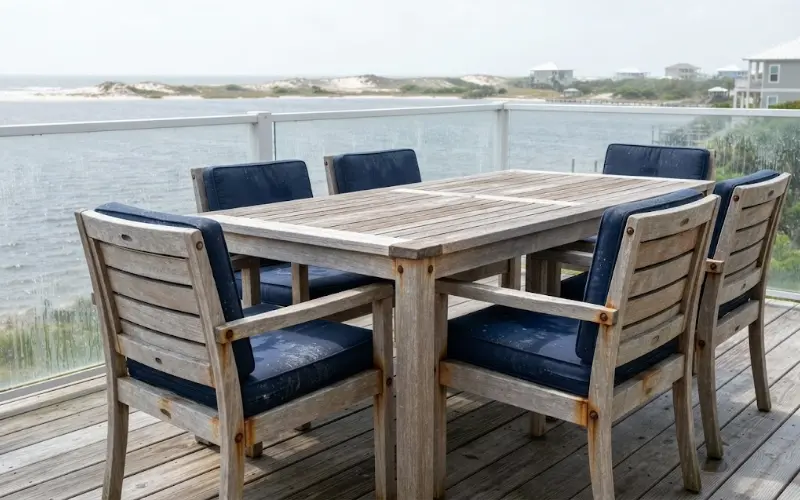
Living anywhere from East Hill down to Pensacola Beach means dealing with a unique microclimate mix of salt-laden sea breezes, heavy summer humidity frequently topping 80%, and intense UV glare through waterfront windows. Standard MDF cores swell, unsealed tropical hardwoods warp, and economy spring packages rust within three seasons. Protecting your investment requires understanding how the Florida Panhandle climate interacts with furniture engineering.
1. The Science of Coastal Decay
Airborne Saline & Oxidation
Airborne salt particles act as an electrolyte accelerator, causing rapid galvanic oxidation in sleeper sofa mechanisms, recliner actuation springs, and uncoated steel nail assemblies. Once rust anchors into internal framing junctions, structural squeaks and frame failure follow rapidly.
Moisture Cycling & Bowing
Relative humidity shifts cause wood fibers to absorb and release ambient moisture. Kiln-dried lumber restricted to low EMC (equilibrium moisture content) targets resists seasonal bowing far better than green or partially dried budget alternatives.
2. Wood Choices That Survive North & West Florida
Recommended Species
- Teak & White Oak: High natural oil content or dense grain structures resist moisture ingress.
- Properly Sealed Acacia: Budget-friendly when finished with marine-grade polyurethane seals.
Materials to Avoid
- Unsealed soft pine subject to rapid microbial and moisture uptake.
- Low-density particle board and MDF cores that laminate-peel in damp environments.
- High-gloss solvent lacquers prone to micro-fracture crazing under UV-humidity stress.
3. Upholstery & Cushion Rules for Gulf Coast Living
Performance Fabric Selection
Standard cotton-blend jacquards trap ambient moisture, breeding mold spores beneath the surface. Solution-dyed acrylics like Sunbrella or engineered stain/moisture barriers like Crypton block liquid penetration while maintaining breathability.
Foam Density Requirements
Specify high-resiliency (HR) foam rated at 2.5 lb density or higher with Dacron wrap. Lower-density foams degrade prematurely when subjected to humid indoor ambient air cycling.
4. Local Placement Checklist for Pensacola Homes
UV and Thermal Buffering
Position natural wood items at least 3 feet away from unfilmed floor-to-ceiling sliding glass doors facing Pensacola Sound or Escambia Bay to prevent thermal shock splitting.
Air Circulation Safeguards
Leave a 1-inch clearance buffer behind large casegoods pushed against perimeter exterior masonry walls to eliminate condensation trap zones.